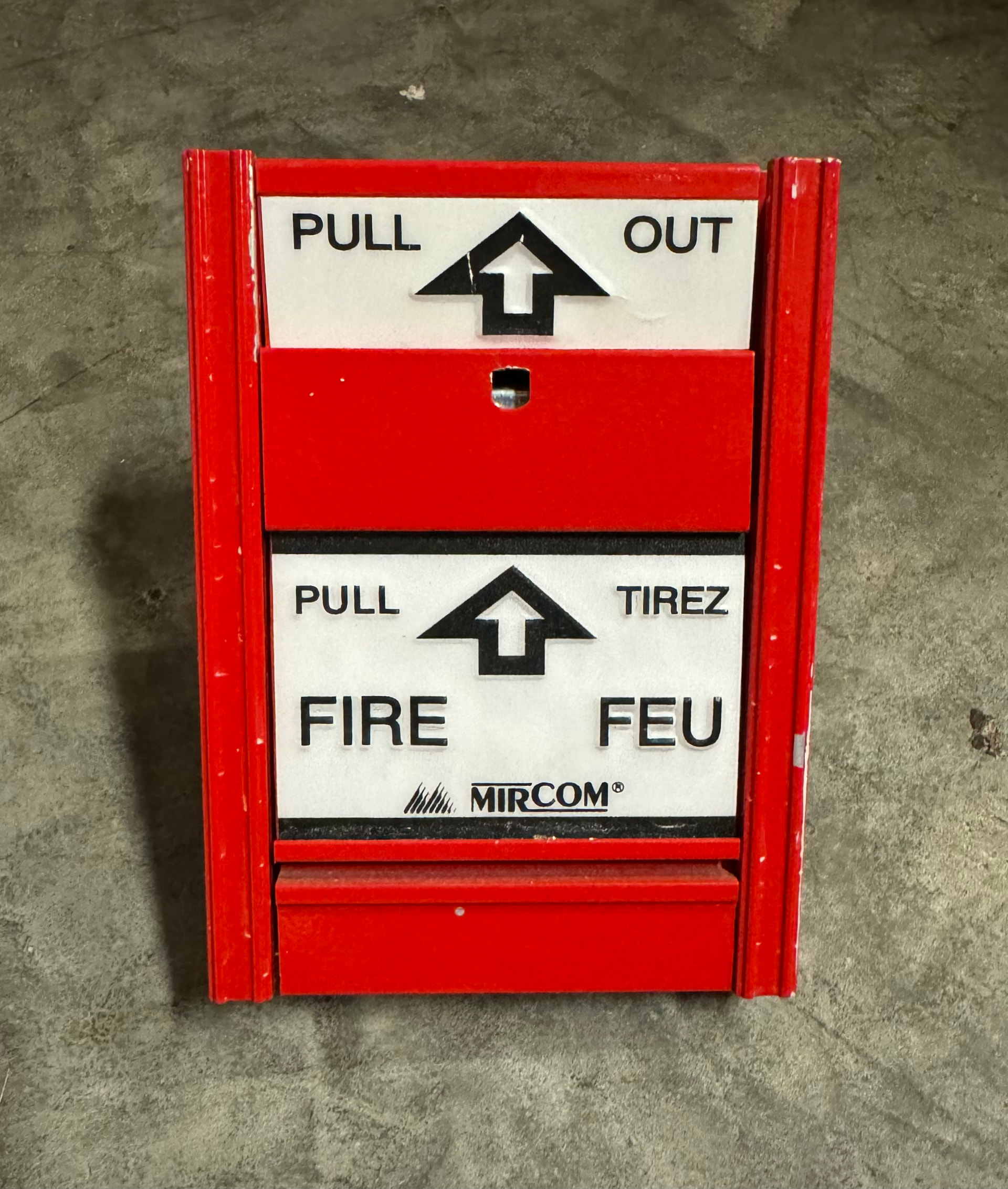
I’ve come across a few devices with manufacturing errors, and I find these devices particularly interesting from a collector’s perspective. I’ve included photos of various pull stations featuring errors below. Has anyone else seen devices with manufacturing errors? If so, I’d love to hear about them!
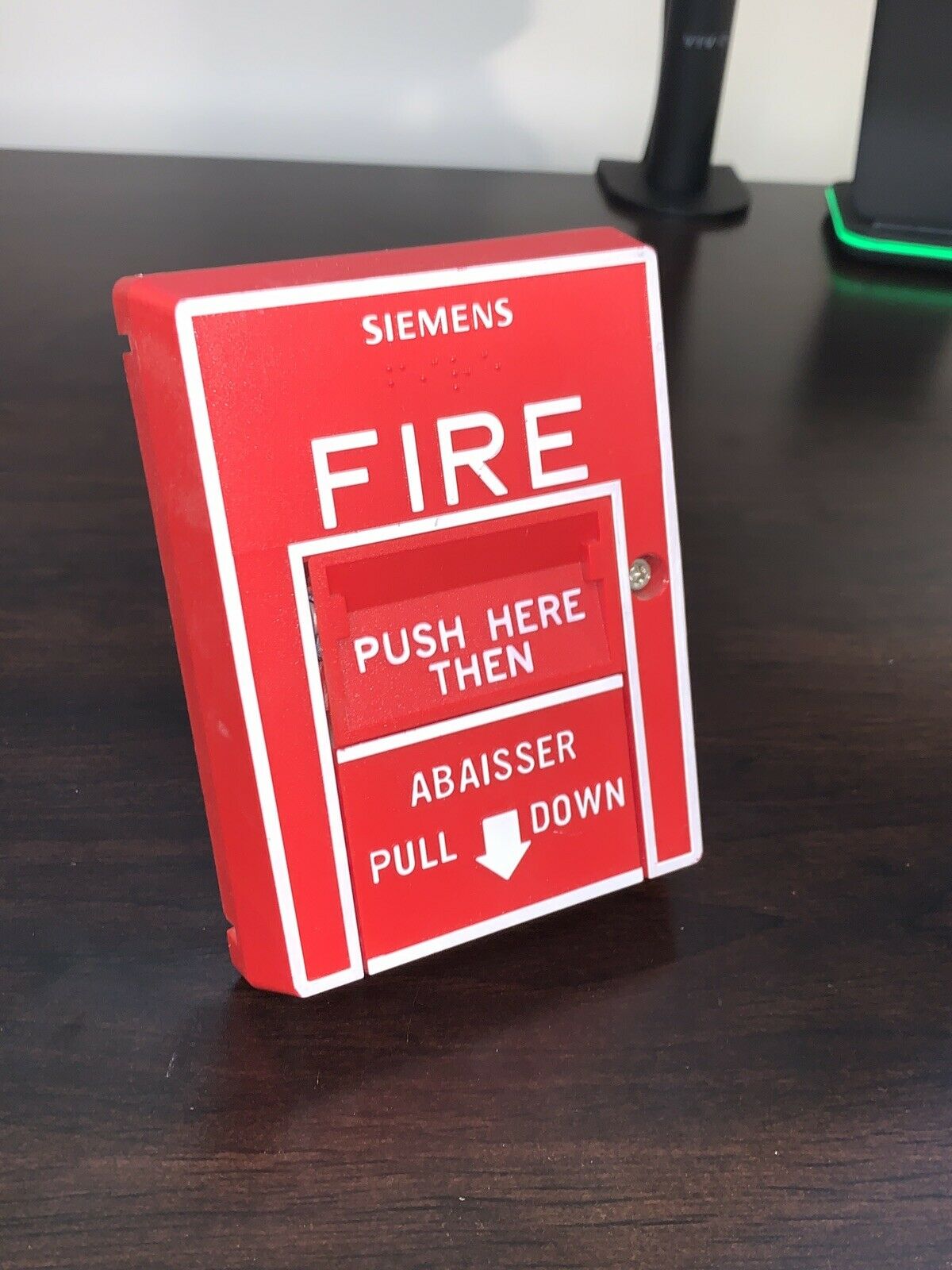
A US-market Siemens pull station with a bilingual handle (photo is from a past eBay listing):
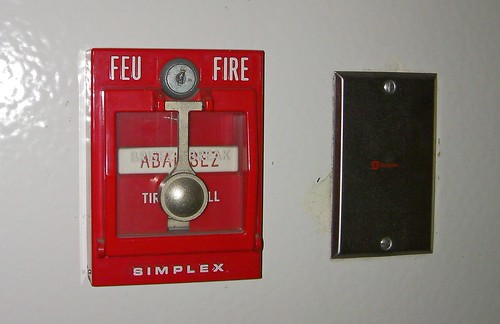
This MS-401AD belongs to a fellow collector. In addition to the mismatched labels on the front cover (in fact, a normal bilingual model would only have one label—the lower one), this device features both a UL sticker and a ULC sticker inside; it seems that normal MS-401s only feature one of these stickers as there are separate models for the US and Canadian markets. The model number inside this unit formally identifies it as a Canadian model.
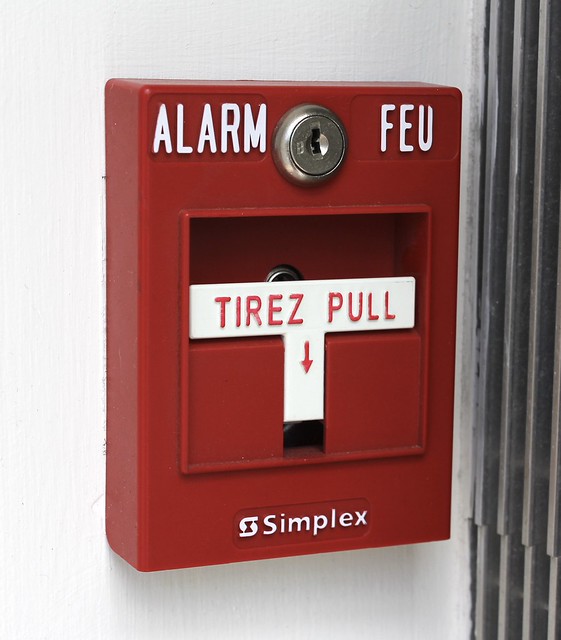
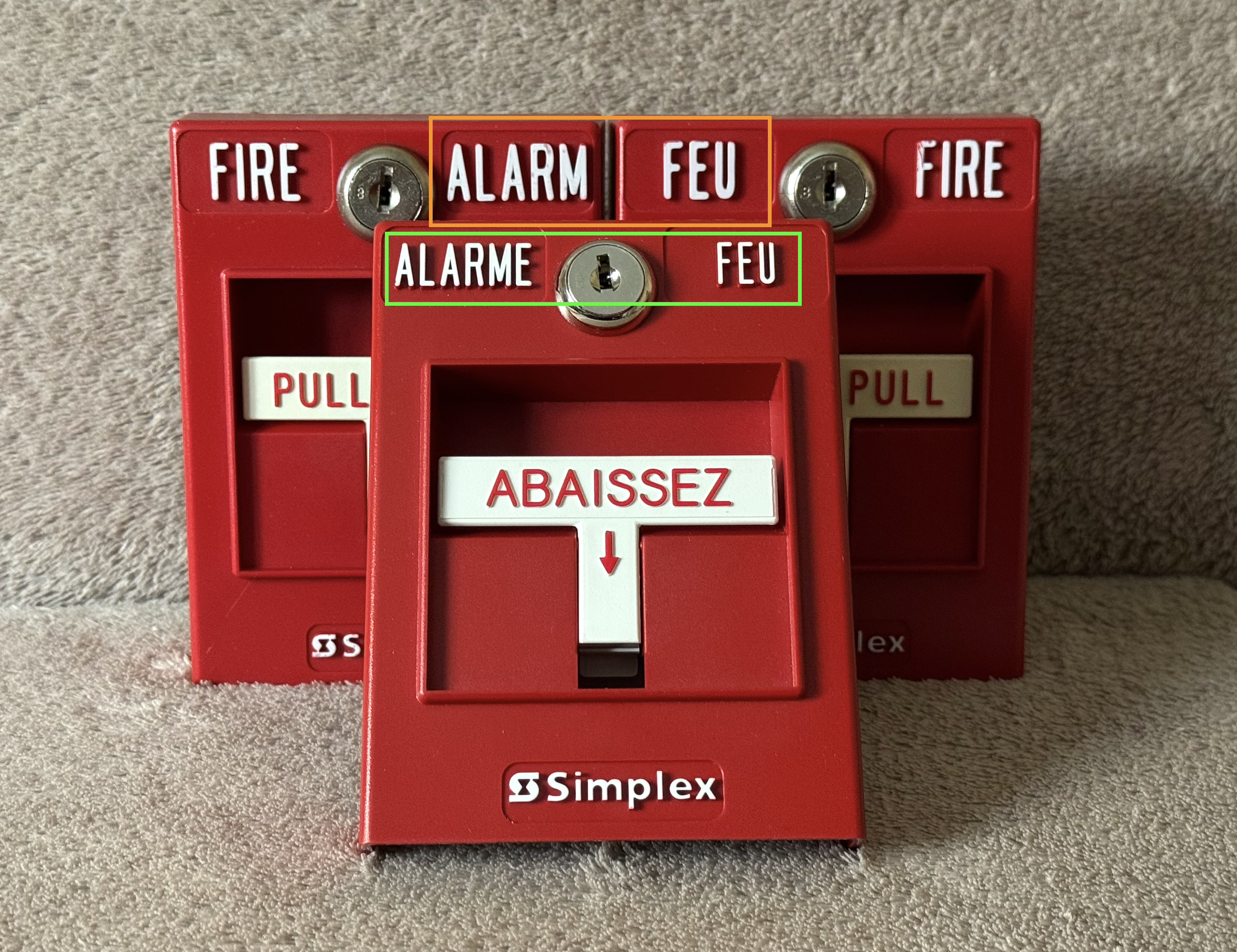
And, last but most definitely not least, a Simplex 2099 or 4099 with mismatched lettering:
This last device is particularly interesting: unlike the other pull stations shown in this post, the apparent error here is the result of a molding error rather than an assembly error. Instead of reading “FEU - FIRE”, this pull station reads “ALARM - FEU”, which makes no sense as the text in the two languages is mismatched; I can’t think of a reason why this combination of words would have been chosen intentionally. While I’m not familiar with the manufacturing process for these pull stations, I wonder if the desired lettering is created by using inserts—one for each word—that are placed within the main mold. Assuming that this is indeed the case, my hypothesis is that the intention was to produce a batch of French-only pull stations with “ALARME - FEU” lettering but that the wrong text inserts were used (an “ALARM” insert for an English model and a “FEU” insert for a bilingual model—note that the “FEU” text is larger on bilingual models than it is on French models); once this mistake was noticed, these moldings were fitted with bilingual handles to make imperfect bilingual pull stations instead of being discarded. To illustrate my hypothesis, here’s a photo showing the combination of lettering that appears to have been used (in orange) and the lettering that was likely intended to be used (in green):
Interestingly, that may be intentional—it seems that certain older Pyrotronics signals are configured in that manner. I learned about this a few months ago when a fellow collector mentioned owning a few Pyrotronics signals with reversed polarity markings; his hypothesis is that Pyrotronics marked its signals according to supervision polarity.
I have a BDC-624 bell from the 1970s that didn’t work when I tried testing it. Now that I know about this quirk, I’ll have to retry it with reversed polarity.
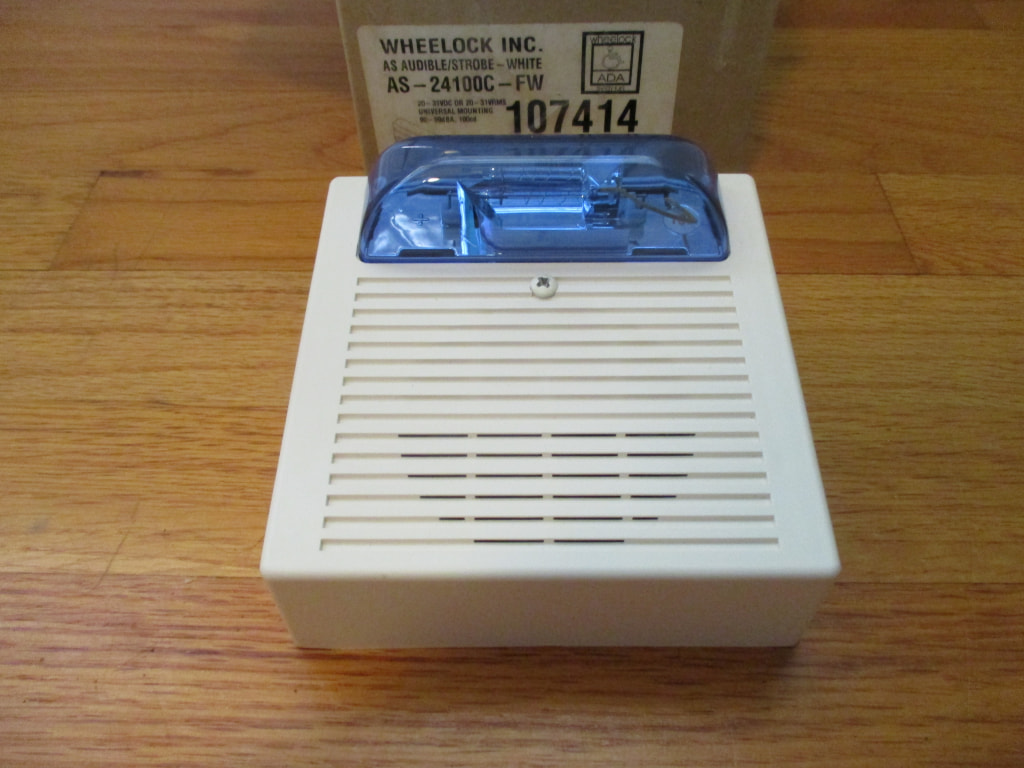
As you might be able to see, the label on the box (plus the fact that it has “FIRE” lettering on the sides, which you can’t see in this photo) indicates that it should have a clear-lens strobe, but it has a blue-lens one instead for some reason! (no idea what device it might have come from or how it got onto this particular AS, but it had it when I got it (from a third-party seller mind you, not directly from Wheelock themselves), & it’s quite unique regardless)
Wheelock did make a blue-lens ASB-24MCC-NW, but the device in your photo appears to be single-candela, and the FIRE lettering is strange. Also, it might just be the lighting, but the blue on your device looks lighter than the blue Wheelock strobes I see online.
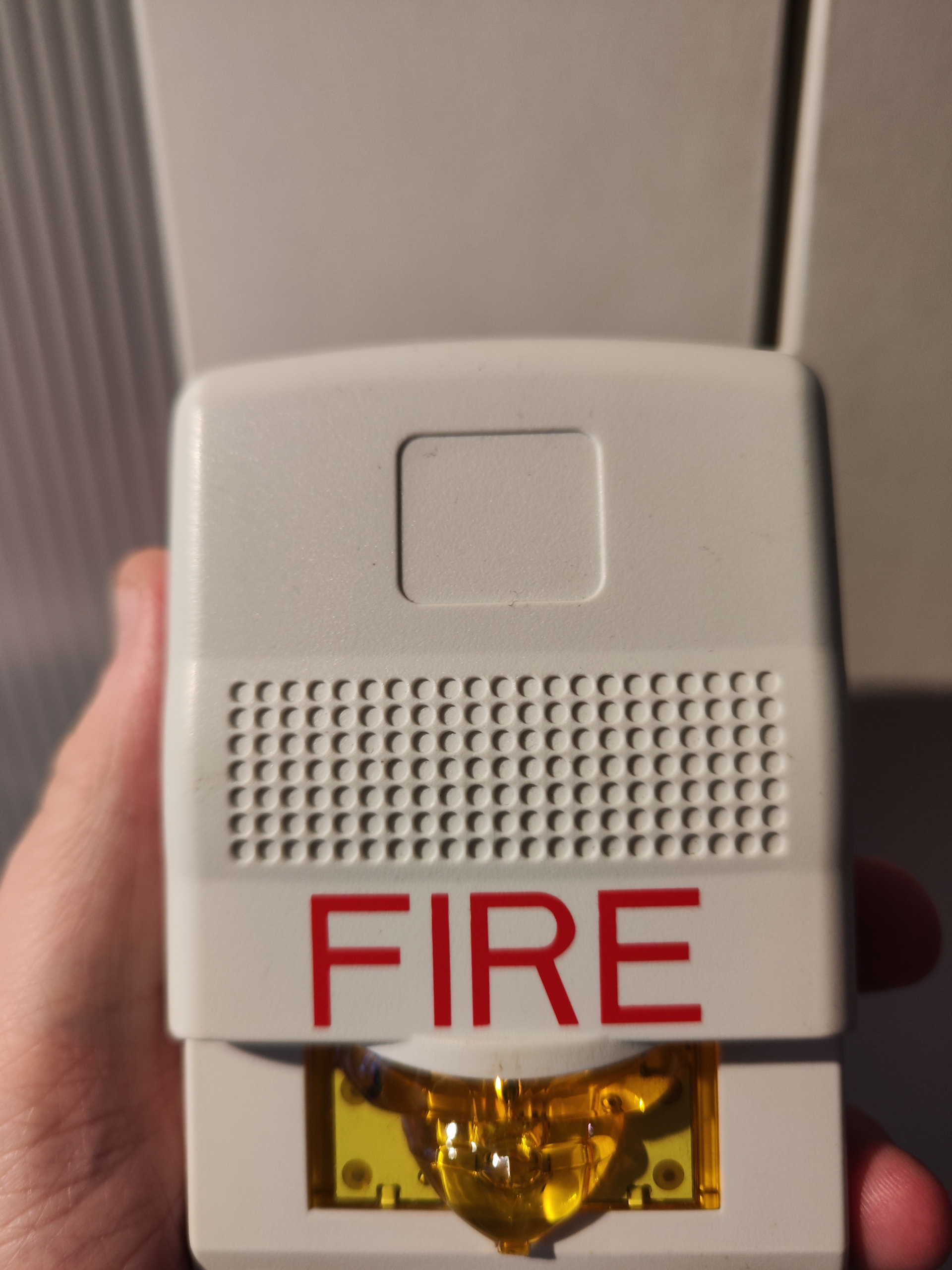
I’ve got a Wheelock Exceeder that also has the same thing, it has fire lettering on the case, yet it has an amber lens. According to the label it’s a LSTW-NA.
Odd. That cover is from an Edwards-rebranded Exceder LED though (as Edwards did so for a time until they could get their own LED NAs developed & released), so maybe that has something to do with it (someone (& I don’t mean Edwards or Wheelock: whoever owned it previously (if anyone else did at least) simply put the wrong cover on it at some point).
I checked, & from the looks of it there doesn’t appear to be any evidence that it’s just protective film, & going by the feel of the strobe (since protective film likely wouldn’t feel the same) it’s the actual lens. I did find a photo online of an AS-24100C-FW, & sure enough it is indeed supposed to have a white-lens strobe, mine just apparently doesn’t for some reason.
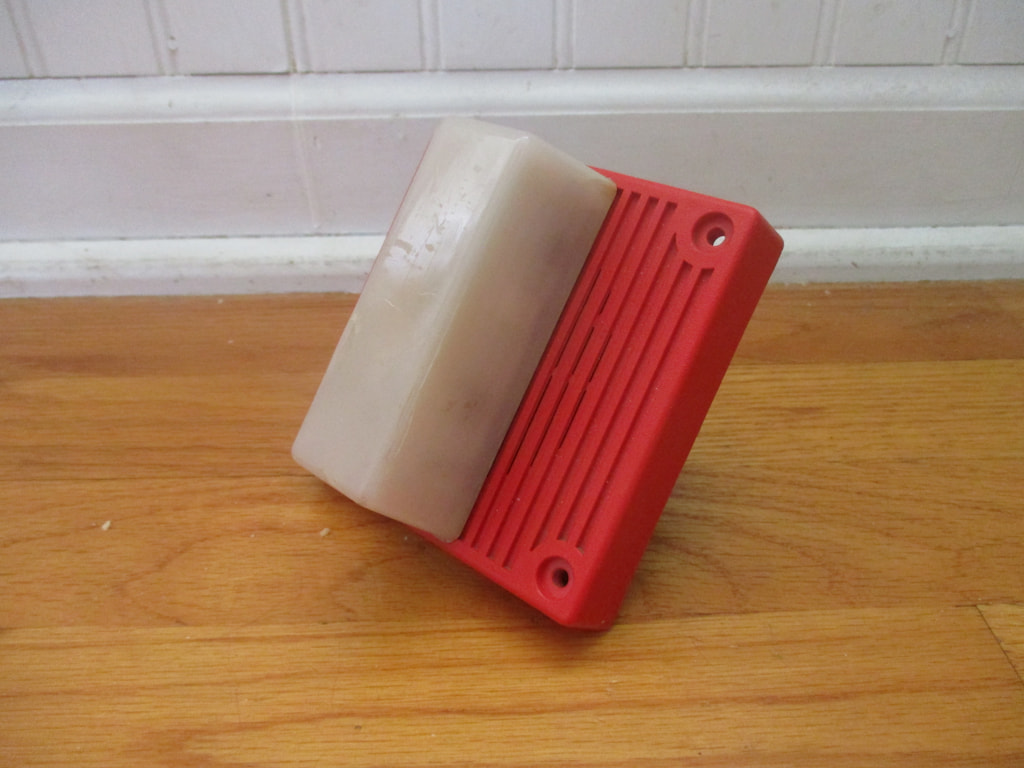
Another bizarre device that might have resulted from a manufacturing error that I have (which I was reminded of while digging my Wheelock stuff out to check that blue-lens AS): a Wheelock “EHS-EL1-WI”, basically an EHS-EL1 with a blank lens! (though just the same the “WI” might somehow indicate “blank lens”):
Correct, the model number for the blue lens version would be ASB-24100C-FW, but I don’t think that exists.
The FIRE lettering may have just faded away. I think I have seen EH(S)-EL1 horn strobes with FIRE lettering that was mostly faded away but still barely visible.
On this UL listing, the EW-EH1 (slow whoop version of the EH-EL1) has housing color options R (red), S (silver), W (white), WI (?), WR (?), and X (custom?). Since this was a non-strobe model, it could not have had any option for the FIRE lettering. If you have a regular red EH-EL1, the difference might be the material the housing is made of. If I remember correctly, back in the 1980s, Wheelock produced an ET-1010 and ET-1010P, where the only difference was that the latter used plastic housing, and the -WI might have a similar meaning here (although I would expect WR to mean red housing using the alternative material).
Also, did you see the model number on a box or on the device itself? The model number on the device usually doesn’t include information about color and lettering, so in that case, it may be an EHS-EL1-WH with a faded H that looked like an I depending on the font. The EHS-EL1-WH was the 15 candela version of the EHS-EL1.Here is an EH-EL1-WH-24-WI.
Yeah. Who knows how the AS I have got its blue lens strobe honestly.
I’ve looked at my WI’s lens closely multiple times & I can’t seem to find any evidence of there once being “FIRE” lettering on it, so I don’t know: either someone fitted the wrong lens at the factory, forgot to stamp it with the appropriate lettering, or a third-party replaced the strobe I guess.
I have no honest clue what the “WI” could mean, but I do have a more standard EHS-EL1 (no “WI”), & it’s got “FIRE” lettering as it should.
My WI didn’t come with a box & thus the only model number is on its label, which is indeed “WI” at the end. Huh though…
There might still be a no-lettering option available by special order, similar to modern devices. The full model would probably be EHS-EL1-WI-VN, whereas a standard one would be EHS-EL1-WI-VF.
Is the housing made from the same material, or is there some difference in texture (e.g. more rough paint)? The 816T had textured paint but the 806T did not.
I looked again at my yellow fire Exceeder, and it turns out it came with two shells..? The “EST” shell with the fire lettering and another blank shell.
Here’s the kicker though, the blank shell has “Fire Alarm device - do not paint” embossed (?!?!?) unless Eaton used the same molds for the mass notification version, I don’t think this is normal.
I don’t have a photo of this, as it would be almost impossible to get a photo that shows the “problem”. My description will have to suffice. The reason I put “problem” in quotation marks is that it’s not really much of a problem. It’s just a bit odd, and could be confusing to the fire alarm technicians.
There is a Siemens OP921 detector in my school that seems to blink a greenish/yellowish white color when polling normally, rather than the typical green color. I thought I was just seeing things at first, but I keep seeing it on one specific detector. I don’t usually notice them polling, but this is a little more eye catching than the usual deep green color.
If you don’t know how the LEDs on modern Siemens addressable devices work, here’s an explanation: A green led flash every once in a while is normal. This can be turned off in programming for aesthetic reasons, or to not disturb people in a dark room. A yellow flash every once in a while means that the device is in trouble. For example, a dirty detector or an XMS- series pull station with the cover removed could cause this. A red flash roughly once per second means that the device is in alarm.
What I Think Happened:
Based on the way it looks, and the fact that there is no trouble on the panel, I think there was simply an odd manufacturing error in this detector where the yellow and green LEDs were wired together. The detector seems to be completely normal other than this, and has passed both the system’s initial verification, and its first annual test with no issues.