EST 90’s History?

Is anyone able to help me out? I have a few places in mind that have 90’s EST systems. I don’t know what the panels are as I don’t have access to them. I’d really like to at least have a decent guess as to what they are. I know pretty much the entire history of Simplex and Siemens/Cerberus Pyrotronics panels as they have been well documented in things like this, but I know almost nothing about EST.

If anyone knows anything, I would greatly appreciate anything you know about the EST panel lineup in the 90’s.

2 Likes

According to my research, EST was selling at least 4 panels in the 1990s: the IRC-3 (1989-2006), the EST1 (1995-2002), the EST2 (1995-2012), & the EST3 (1996-2023).

2 Likes

The annunciator at the place I’m wondering about the most has buttons like the ones on the one pictured below, but it has no screen and is a conventional LED annunciator.

1 Like

I don’t know about the one you’re describing specifically, but the one in the photo is an EST 2-CMDN, which is an annunciator for the IRC-3, so it might be that.

2 Likes

Is it perhaps a SAN annunciator, like the one shown below? I took this photo at a cinema that opened in 1995. The buttons are quite different, but the LED indicators are of the same style. I can’t think of any EST annunciators that aren’t equipped with an LCD and have buttons similar to those used on the SMDN/CMDN; it’s quite possible, however, that I’m not aware of such a product, as EST had quite the lineup in the 1980s and 1990s.

The SAN could be used with the IRC-3 and EST2. A similar annunciator, the RSA4, was offered for the LSS4.

1 Like

Now that I think about it, I think it is almost exactly like the one you showed. Do you know of the LSS4 was sold in the US of if it was a Canadian specific product? If it was sold in the US, I think that the system near me probably uses one of those panels as it is a small conventional system from the mid-90’s with only a couple of zones. The signals are 792 horn/strobes and their remote strobe counterparts.

Also, did the annunciators for the LSS4 have a security LED? Next time I go there, that would be a good thing to check.

Thanks so much for the help (you and @TheCarson116 )! I really don’t know much about EST/ Edwards’ past lineups and products, as they were mostly only common in my area in the 80’s and 90’s so most of the panels have been replaced by now.

It’s also cool to see more inside that annunciator, as the one near me has more tinted glass so it is hard to see in. I’ve also never seen any more than the green power LED illuminated.

1 Like

The LSS4 was indeed sold in the States. In fact, I don’t know if it was sold in Canada; I’ve never seen one here or even heard of an installation in Canada that uses one of these panels. It seems that the 6616/6632 and ESA2000 filled the LSS4’s slot on the Canadian market at that time.

The RSA4 looks almost identical to the SAN, but it doesn’t have a security LED. Instead, it has an indicator labelled “auto evacuation cancel”. This listing shows an RSA4.

Regarding the window, the datasheet for the SAN mentions that the cabinets feature a bronze window. It sounds like the one you saw has this type of window. I wonder if this feature was added later, given that the one in my photo doesn’t have a tinted window.

1 Like

I’ll definitely have to look at the labels next time I go there.

If it was an option that was added later, it couldn’t have been much later as the building I saw that in was built around 1995 as well.

Thanks!

1 Like

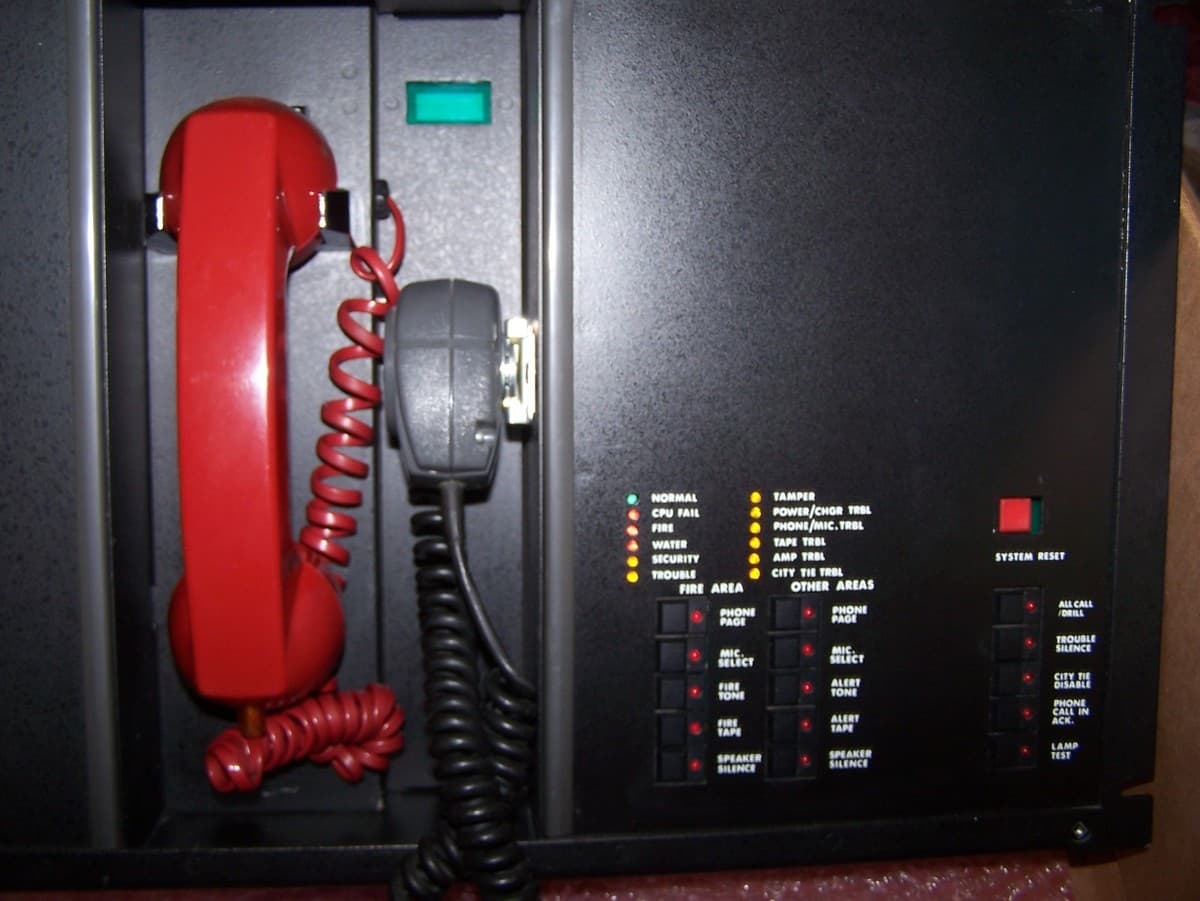
Here’s the FCCA audio control panel that would be with the EST IRC-3. The document was released in 1995.


This is a FCCA from an eBay listing, which might be the FAST version.

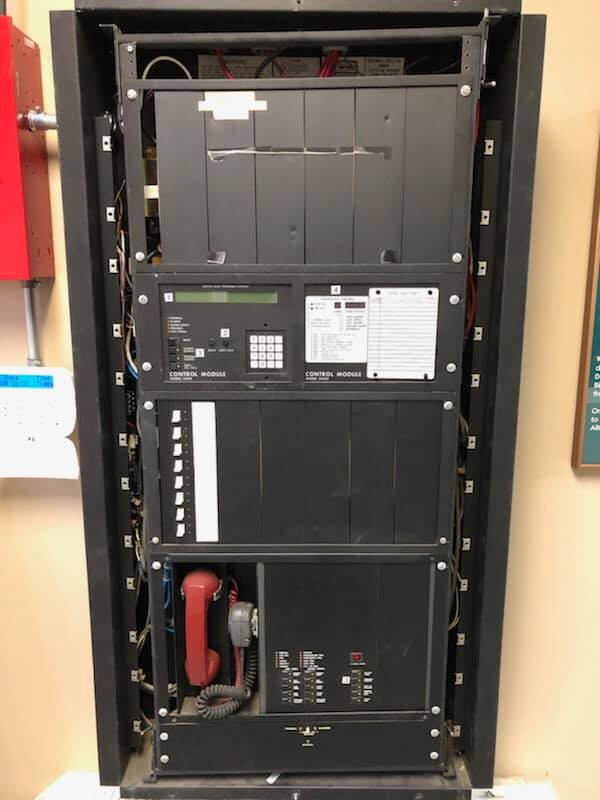
Found this image on Facebook of what an average IRC-3 system with the FCCA would look like.

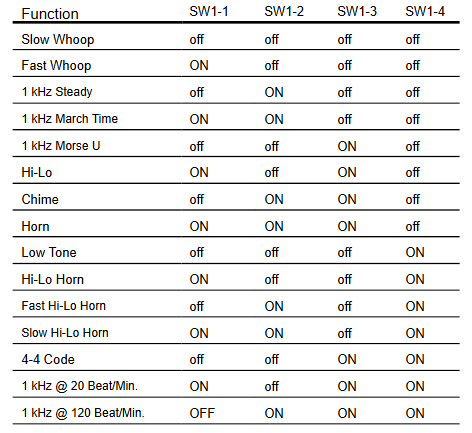
The FCCA had 15 tones, as listed down below:


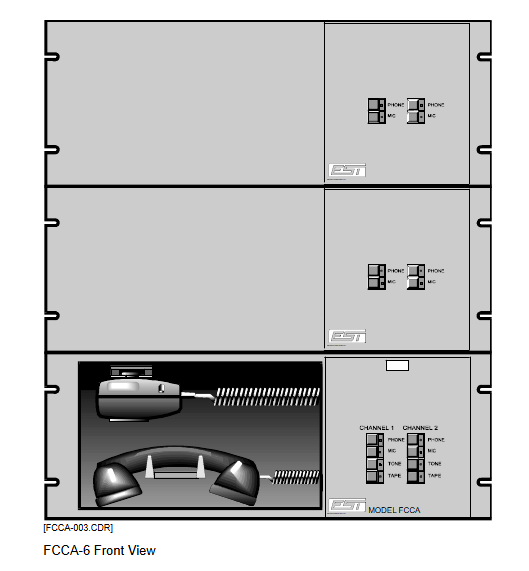
6-channel FCCA from the manual.

3 Likes

I think of Undertale when I seen that


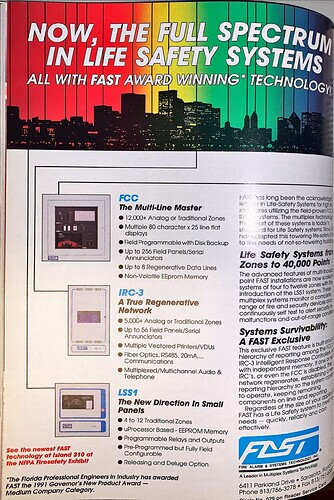
Although this was before EST existed, the IRC-3 existed before, as shown in the brochure I found from this forum post LOTS of Old Brochures - #28 by anon29828191

2 Likes

FAST has been around for a bit but I cannot exactly date back the time they were first established but somewhere in the 80s the IRC-1 made its showcase

In 1989 FAST Showed its first brochure of the IRC-3 Labeled as the “Response 3000” fast forward 1 year to 1990 another brochure showed up with the FCC, an even larger version of the IRC-3 now boasting the Response 3000 name while the smaller sibling panel got the IRC-3 name. In 1991 the Response 3000 would later become the FCC panel, dropping the Response 3000 name all together as shown in the ad posted by Illomenga23

The IRC handled well over 5000 points, addressable or conventional while the FCC would support over 40,000. These panels used the CM2’s which were a sort of transponder panel. They had a dedicated CPU and 2 card slots for either a ZAS-1 Analog CLIP card, a ZB8 Zone card or any other combination you wanted. Each CM ‘Module’ would only support 2 cards per module so in order to Achieve a larger system cap, you would need more CM Control modules. These systems had a wide variety of Annunciator Options, One of which being the SAN Series Annunciators, CMDN Annunciators, RASP Annunciators, An onboard printer module I do not remember the name of, the CCA Computerized Color Annunciator, and a terminal. EVAC was possible through the FCCA and had a capacity for 6 audio channels. Voice would be handled first through the RAMM-A Then later with the MVM. The MVM Had the same design as a CM1N but with some slight differences and hardware changes for audio. The RAMM-A and MVM Allowed for a maximum of 500 individual message phrases but the more channels added to the system would impact the amount of record time you could use.
Notable installs for them were DEN Airport, Luxor hotel, Salt palace Convention center, Elitch garden’s Denver and im sure many more im missing.
The IRC-3 would become very popular even outside the US with some notable installation being the Bejing west railway station, The Intel plant in Dublin, Metropolitan Life building Ottawa.

The LSS Series of panels were the conventional option with the larger panel being the LSS4 which supported up to 36 zones. The panel included an RS-485 bus allowing the use of annunciators like the SAN Series.

While in edward’s land they had introduced the ESA2000 in I believe 1992?, A hybrid conventional/Addressable panel Similar to that of the 4100 (Best described by CJ9899) These panels were DOS Based and not too popular from what i understand but a notable installation of the panel would be the Palisades center in New work. They used their own addressable protocol but I do not know much about them.

In around 1992-1993 Edwards bought FAST to form EST and quickly started slapping the new shiny EST name over the original FAST one. In around

In 1994 EST Would introduce Signature series in A brochure, EST Would later release the ZAS-2, A SIGA Addressable card for the IRC-3/FCC

In 1995 EST Would introduce EST2, the first native SIGA Panel with 1000 points and EVAC. These panels would inherit a lot of the functions and control from the IRC/FCC and even use the SAN Annunciators as well

1995-1996 would dawn the EST3, a panel that from my understanding was in Development since 1994? But would not see full release until roughly 1995/1996. The panel also inherited a lot of the IRC-3/FCC Traits and became their new flagship panel with 8 Channels of audio, 64 panels and 160,000 Devices across all 64.

Cannot comment on EST1 as I do not know its history well

This is all the information i can provide at the moment but if i was wrong somewhere somebody please do correct me as all this information is best to how i understand it looking through a lot of documentation and speaking to some techs

I will add to this list as I gather more information or remember things to add

3 Likes

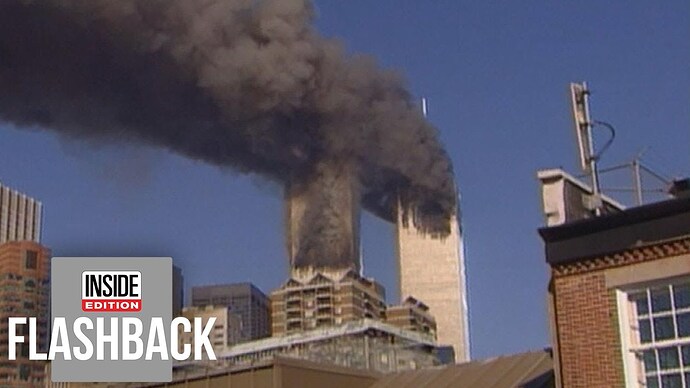
A notable installation of the IRC-3 was at the Marriott by the WTC before 9/11.

At 1:00, you can hear the 4-4 tone. At 1:55, it does the slow whoop/Z23 enable. At 2:33, it does some sort of page tone.

1 Like

Yeah, I hear it, but what I’m confused about is that the “standard” Edwards/EST “4-4” tone is 1195 Hz, while that one is 1160 Hz instead. It’s also heard again at 2:31 (even though that was supposedly the same floor the whoop tone was just sounding on).

On another note, do you think the different tones had to do with the system being two-stage maybe? (or at the very least being “gradual evacuation”, with some floors getting immediate evacuation orders & others being told to wait at first, which of course is a good idea in a building as large & populated as a hotel)

Not sure why the 4-4 sounds like that, could’ve been the audio quality. Not sure if there was a two-stage system there.

No idea why the audio quality would have been bad enough to alter the pitch that much but alright.

Me neither, but it or a “gradual evacuation” setup wouldn’t be out of the question in a building like that.

Most likely the inquiry tone as NYC systems only really have two tones, a fire tone (usually slow whoop) and inquiry tone which has to be different from the fire tone (usually some sort of beeping tone).

Inquiry tone is sounded automatically to all floors that aren’t in the alarm zone (floor of alarm, above, bellow) if the panel is not acknowleged within a certain time or as soon as any alarm occures just depends how it was configured, it’s used to alert the Fire Safety Director in case they are not at the panel to hear the alarm they would hear that tone and know to respond.

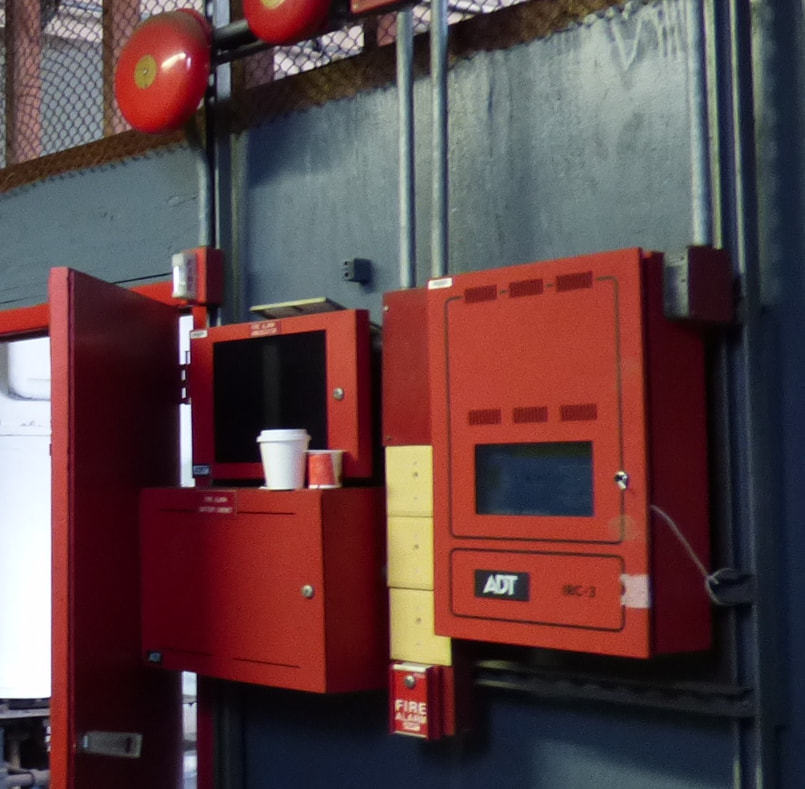
anyways here is a ADT rebrand of the IRC-3 i have found before somewhere around NYC area

2 Likes

That’s actually a really good idea! I wonder what that would have sounded like in other buildings, like WTC7 or even the new One WTC? Based on recordings, I think the inquiry tone on the MXL-V system in at least WTC 2 but possibly WTC 1 was a 900hz continuous tone.

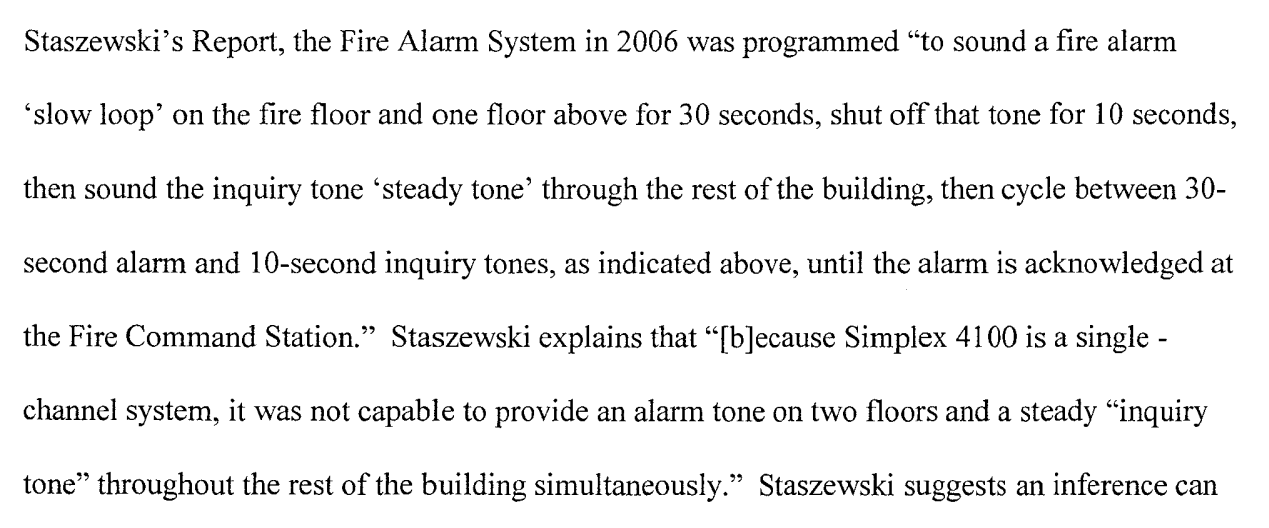
My guess is the so called “Fire Department Alerted” chime tone that people referred to in the original building 7 was the inquiry tone, because the system was most likely single channel, it could not broadcast 2 tones at the same time to different floors, so it would pause the fire tone and broadcast the inquiry tone (most likely because the lobby was in alarm already it played both after another). the EVAX voice systems actually mentions this for their NYC operation mode for single channel systems which kind of describe exactly what that system’s sequence did.

seen few other documents on NYC systems setup in a similar way, but then again this is just a guess so do what you will with it.

few videos of the setup mentioned above
https://youtu.be/zBw7OMhbkqo?si=nousfvnSFehNFMT3
https://www.youtube.com/watch?v=xFoFGy9Frzo

2 Likes

Ah okay, so my idea of “gradual evacuation” was sort-of correct then. Neat.

Oh? Cool! Nice find! (now if only someone else could find & preserve it)

Interesting…