1 Like
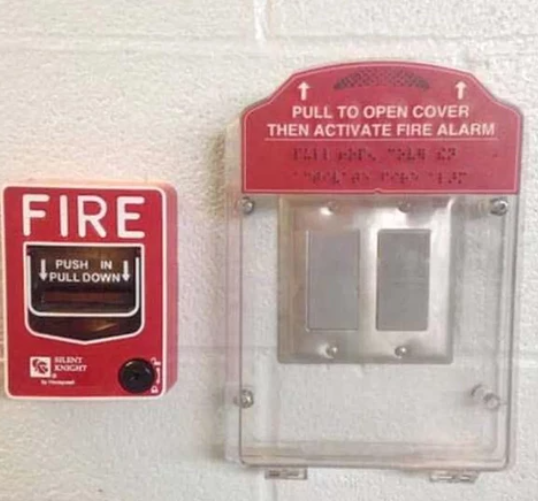
Definitely, though how somebody could have possibly made that mistake in the first place I have no idea!
I hope that tehy dont think that the pullstation is the light
Just so you know, a similar thread already exists
I saw that on Fire Alarm Fails.
Not sure how they can mistaken a switch plate for a pull station.
yeah I am the one who submitted it I think
1 Like
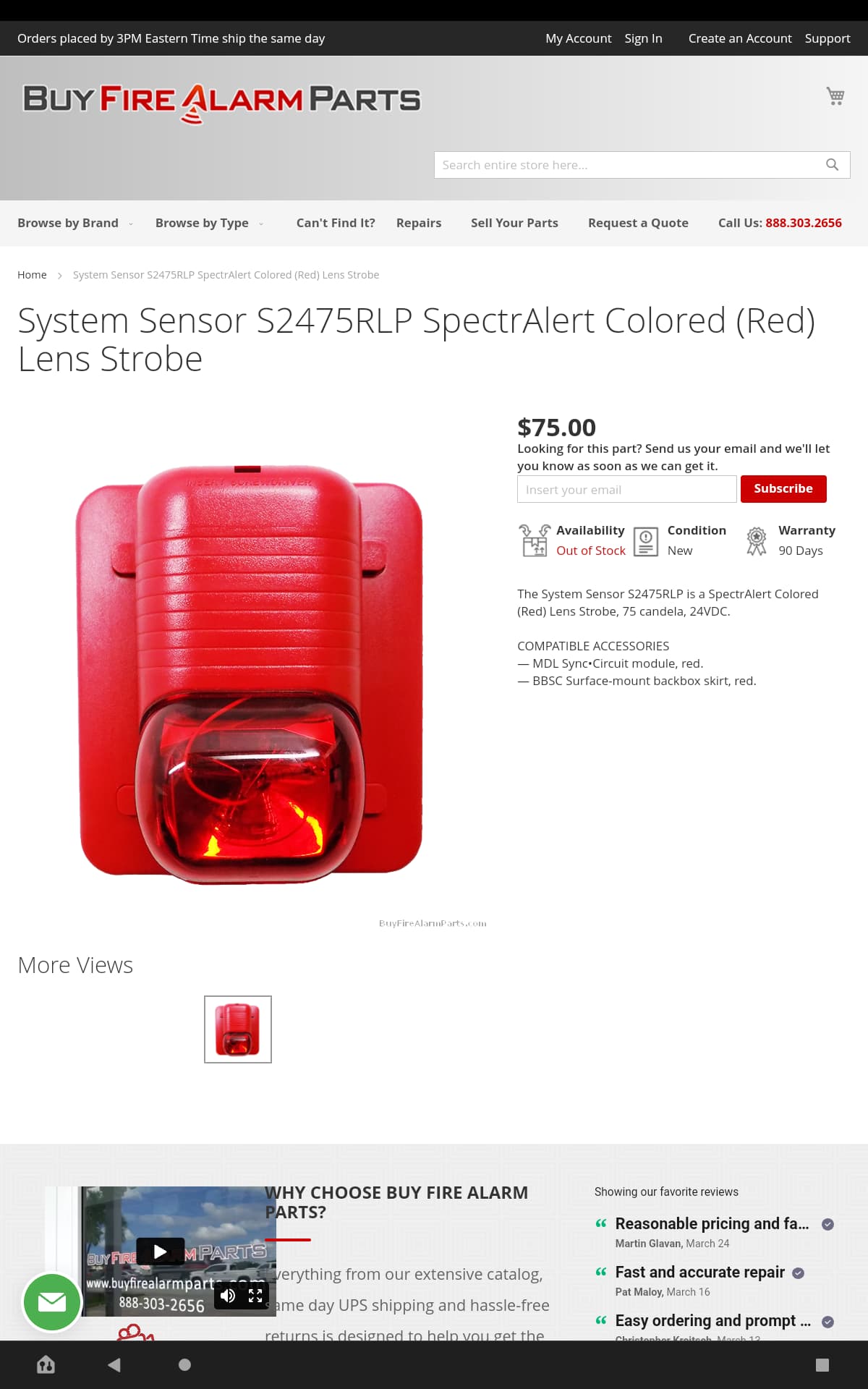
I think that was made by system sensor for the New Zealand market, so it’s a legit alarm
1 Like
The Asian & Pacific Rim markets specifically I believe (though blank colored-lens SpectrAlerts like that one were also made for general signaling applications anywhere, including North America).
2 Likes
Yikes. I don’t want to know what was going on when they did this.
this be sillier than mounting an ch-70 inside-out
Eaton’s page for weatherproof horns has a strange image of a product that has never been released to my knowledge. Although this is on a page related to the AHWP, it is the size of an AH or ASWP, and it has FIRE lettering, which neither the AH nor AHWP had. I don’t know how this image of a nonexistent product ended up on their website.
1 Like
I can’t seem to see/find it on there & the copy you posted in this topic is broken for some reason. The AS & AH also belong to the same model series & thus are the same size (& I’m pretty sure that most models in said series have “FIRE” lettering as well). Are you referring to the EH-style horn on that page that is for some reason called the “AH-24WP-R”? (which doesn’t have “FIRE” lettering as far as I can tell)
This is the image I am referring to.
Like many other remote horns, the AH does not have FIRE lettering because FIRE lettering is mainly useful to identify the purpose of a strobe. There are many photos of the AH online (such as here and here) without FIRE lettering, while this image from Eaton (and numerous reuploads on other websites) is the only one I could find with FIRE lettering.
Also, as far as I know, the AHWP has always been the size of an EH-EL/MT4, which makes looking at this AH image hurt more.
Going by what I said below that might just be either a super-rare “FIRE”-lettering AH-24-R (“AH-24-FR”?) or an AS-24MCW-FR with an AH’s cover plate edited on top of/put in place of the strobe.
Well regardless I still think properly labeling a device, whether it’s a horn/strobe, remote strobe, or remote horn (or any other type of device), is always important (& should always be done for that matter) so that everyone knows what it is/what it’s for.
Those are the first ones I’ve seen I think: I believe most of the photos I’ve seen were of AHs with lettering (though maybe I’ve just never noticed most AH-series models lack the fire lettering, especially with how rare they are).
Would there be any reason for Wheelock to make their AH-series devices smaller than the AS-series? I don’t think so (heck the AH-24-R is literally just an AS-24MCW-FR with the strobe replaced by a cover plate & thus they’re the same dimensions).
Going by what I said below that might just be either a super-rare “FIRE”-lettering AH-24-R (“AH-24-FR”?) or an AS-24MCW-FR with an AH’s cover plate edited on top of/put in place of the strobe.
I’ve seen that happen a lot with the NH and NS, which is where I assume the FIRE-labeled NH horns came from, since I have never seen any datasheet mention a FIRE-labeled NH, and the 2009-2010 catalog does not mention a FIRE-labeled NH or AH (although a special order would definitely be possible). However, I don’t think the AS was designed with an interchangeable cover the way the NS was, so a special AH cover would have been made with FIRE lettering.
Well regardless I still think properly labeling a device, whether it’s a horn/strobe, remote strobe, or remote horn (or any other type of device), is always important (& should always been done for that matter) so that everyone knows what it is/what it’s for.
Until the 1990s, many devices had their FIRE lettering directly printed on the strobe, which meant remote horns did not have FIRE lettering, and most manufacturers continued this practice on remote horns through the 1990s. The AH does have a “FIRE ALARM DEVICE - DO NOT PAINT” engraving on it, which should communicate its purpose to anyone performing maintenance, but the intended response from a horn is “leave the building,” not “walk around to locate the source of the sound, then read some text on the horn and leave the building afterward” which is why I imagine many manufacturers did not see a reason to put FIRE lettering on remote horns. This is still the case with the Eluxa horns (although the Eluxa remote speakers do have FIRE lettering by default).
Those are the first ones I’ve seen I think: I believe most of the photos I’ve seen were of AHs with lettering (though maybe I’ve just never noticed most AH-series models lack the fire lettering, especially with how rare they are).
I definitely did not notice this until recently, but now that I checked, this is the only AH with FIRE lettering I can find anywhere. Do you have any links to photos of AH horns with FIRE lettering?
Would there be any reason for Wheelock to make their AH-series devices smaller than the AS-series? I don’t think so (heck the AH-24-R is literally just an AS-24MCW-FR with the strobe replaced by a cover plate & thus they’re the same dimensions).
The AHWP was released around 1998 (based on a manual for the RSSP), while the ASWP was released around 2001. When the AHWP was released, it would make sense to use the same housing as the MT4 since the MT4 was already outdoor rated and a weatherproof backbox already existed already existed for the MT4, while there was no weatherproof backbox for a device as large as a regular AH that only required a single mounting screw.
You know, now that I’ve had a look I guess that is an edited photo or AS-24MCW-FR like I said, since all the AHs I found don’t have “FIRE” lettering (except the photo you found).
Oh, had no idea that was the most likely reason for a lot of non-strobe devices not having lettering. Now though times have changed & so should standards for device lettering: manufacturers already moved the lettering on strobe devices to elsewhere so as not to block the lens & diminish the light output, but for some reason don’t put the lettering in those exact same spots on their non-strobe devices (even though they could likely use the same stamping machine programmed the same way & everything as it is). This would just help ensure the device’s purpose would always be known no matter what (which is of course important during an emergency: you want to make sure everyone knows what’s going on & more importantly what to do).
Are you talking about the EH-series-style horn that Wheelock for some reason called the “AH-24WP-R”, because it should be obvious that the actual AH-24 is just an AS-24MCW-FR with the strobe replaced by a cover plate (& thus like I said is the exact same size as an AS-series signal).
Are you talking about the EH-series-style horn that Wheelock for some reason called the “AH-24WP-R”, because it should be obvious that the actual AH-24 is just an AS-24MCW-FR with the strobe replaced by a cover plate (& thus like I said is the exact same size as an AS-series signal).
Yeah, the regular AH-24 is the size of the AS but the AH-24WP uses similar housing to the EH-EL1 and MT4. It is called the AH-24WP because it has the same sound and the same 2-wire horn control functionality as the AH.
Ah okay. No idea why Wheelock couldn’t have simply sold it as an MT-series device then (“MT4-24-R” probably), since it’s pretty much a surface-mount MT for all intents & purposes.
Speaking of odd photos from manufacturers’ websites, here’s something amusing that appeared a few years ago on the home page of System Sensor’s Canadian website. The wall-mount strobe in the image features bilingual lettering, but there’s an error in the French text: it reads “FUE” instead of “FEU”. The image looks like it was edited, as the lettering looks different on typical SpectrAlert Advance strobes (for reference, this is what it should look like).
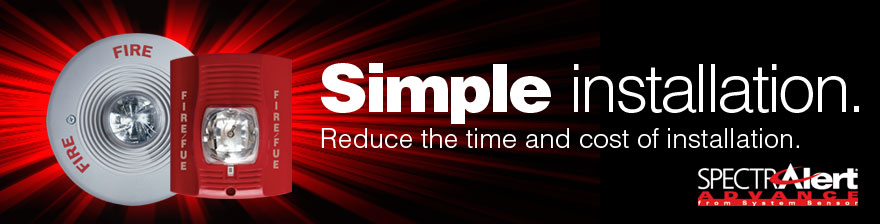

While this error likely never appeared on an actual device, it gave me a good laugh when I was welcomed to System Sensor’s website by this photo.
I hadn’t noticed this initially, but the banner also shows a “classic” ceiling-mount SpectrAlert strobe despite advertising the Advance series.
1 Like